
Mastering Context Management in AI Agents
Managing context effectively is crucial in AI to prevent failures that compromise output quality. Techniques like RAG, Tool Loadout, and Context Quarantine can enhance performance. By focusing on context management, we can ensure AI agents operate efficiently and accurately.
USAGETOOLSFUTUREWORK
The AI Maker
8/24/20262 min read

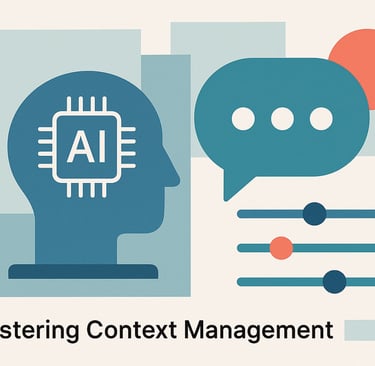
In our ongoing journey through the intricacies of AI, particularly in how we manage context, let's delve into some practical strategies for mitigating context failures. Context management is crucial for ensuring that AI models generate high-quality responses. When we talk about context failures, we refer to issues like context poisoning, distraction, confusion, and clash—all of which can severely impact an AI's performance.
One effective approach to enhance context management is through Retrieval-Augmented Generation (RAG) (https://www.researchgate.net/publication/359192716_Retrieval-Augmented_Generation_for_Multi-Tool_Chatbot_Applications) . By selectively incorporating relevant information, we can help large language models (LLMs) produce better responses. With the rise of models boasting larger context windows, the debate around RAG's relevance continues. The key takeaway? Don’t treat your context like a junk drawer; it’s essential to curate it thoughtfully.
Another method worth considering is Tool Loadout (https://arxiv.org/abs/2208.11895) , which involves selecting only the most relevant tools for a task. Just like preparing for a gaming match, where you choose your gear based on the challenges ahead, applying this concept to AI can drastically improve performance. Studies have shown that limiting the number of tools can enhance accuracy and efficiency, a finding echoed by research on models like Llama 3.1.
Then we have Context Quarantine (https://www.anthropic.com) , which isolates contexts into dedicated threads. This approach reduces the risk of information overload and helps maintain clarity in responses. By breaking tasks into smaller, manageable chunks, we can ensure each context remains focused and relevant.
Context Pruning and Summarization are also powerful techniques. Pruning involves removing unnecessary information, while summarization condenses long contexts into digestible formats. These methods not only streamline the data fed into an AI but also enhance its processing speed and accuracy.
Finally, consider Context Offloading (https://www.anthropic.com) , where you store information outside the LLM's context. This can be particularly beneficial in complex scenarios where maintaining clarity is paramount. By implementing these strategies, you can significantly improve the performance of your AI agents.
Remember, every token in your context matters. As you build or optimize your AI agents, ask yourself: Is everything in this context earning its keep? If not, now you have six effective strategies to ensure it does.
Cited: https://www.dbreunig.com/2025/06/26/how-to-fix-your-context.html
Your Data, Your Insights
Unlock the power of your data effortlessly. Update it continuously. Automatically.
Answers
Sign up NOW
info at aimaker.com
© 2024. All rights reserved. Terms and Conditions | Privacy Policy