
Navigating AI Detection in Student Writing
Students are increasingly using AI detection tools to validate their original writing amidst fears of being accused of cheating. Teachers are adapting their methods to combat AI misuse, creating a complex academic environment. As AI's presence grows in education, the challenge of maintaining integrity while navigating detection tools becomes more pronounced.
USAGEAGENTSWORKPOLICYFUTURETOOLS
The AI Maker
3/9/20262 min read
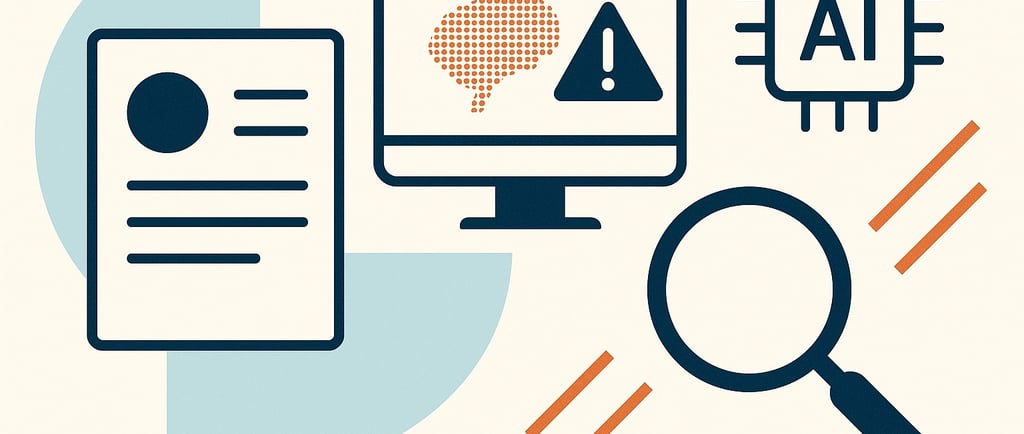
In the evolving landscape of education, students are increasingly turning to artificial intelligence (AI) tools, not just for assistance but as a means of self-preservation against accusations of cheating. With the rise of AI-detection software utilized by teachers to identify AI-generated work, students find themselves in a unique predicament: how to ensure their authentic writing remains untouched by the shadow of AI suspicion.
Miles Pulvers, a 21-year-old student at Northeastern University in Boston, highlights this struggle. He emphasizes his commitment to writing integrity, stating, "I take great pride in my writing." However, the introduction of AI detectors has made him anxious about his submissions, as even original work can be flagged as potentially AI-generated. This scenario is not isolated; many students are preemptively running their essays through AI detection tools, a practice that has become a new norm in academic integrity.
Leticia Villaseñor, a history teacher at a private high school in Los Angeles, observes that the suspicion around student submissions has increased. Many students resort to using AI for writing, only to run their work through detectors to ensure it passes as human-crafted. Villaseñor has adapted her teaching methods by assigning more in-class writing tasks, aware that homework assignments often become a playground for AI misuse.
As the stakes rise, students like Marcus Wooler have found themselves wrongly accused of using AI. To counter this, he and others have taken to running their essays through AI detectors as a precaution. Devan Leos, co-founder of Undetectable AI, points out that even well-written essays can attract suspicion, particularly when students use advanced vocabulary or formal writing styles. "It’s like you get penalized for being a proper writer," he quips.
Confusion reigns among students regarding the reliability of AI detection tools. Harrison Checketts, another student in Villaseñor’s class, ran his paper through five different detectors, only to receive conflicting results. This inconsistency led him to abandon the practice, relying instead on the judgment of his teachers, whom he believes are more adept at identifying genuine student work.
Claire Krieger, a 20-year-old student at Fordham University, echoes the sentiment that AI detectors can provide a false sense of security. She recounted an instance where her citations were flagged, leading to a misunderstanding with her professor. This highlights the importance of personal engagement in academic discussions to clarify authorship and maintain academic integrity.
The fear surrounding AI use in educational settings has resulted in students spending excessive time trying to “humanize” their writing. Jenny Maxwell, head of education at Grammarly, notes that this has created a "police state of writing" where students are increasingly burdened by the need to prove their authenticity. Grammarly has even introduced a new authorship tool designed to help students track their writing process, ensuring transparency in their work.
As this situation evolves, it’s clear that the intersection of AI and education will require ongoing dialogue, understanding, and perhaps a rethinking of what it means to be a writer in the digital age.
Cited: https://www.wsj.com/tech/personal-tech/ai-student-papers-humanize-school-6b13240a
Your Data, Your Insights
Unlock the power of your data effortlessly. Update it continuously. Automatically.
Answers
Sign up NOW
info at aimaker.com
© 2024. All rights reserved. Terms and Conditions | Privacy Policy