
Navigating the Future of AI Agents
The development of AI agents is advancing, focusing on integrating tools and gaining access to various applications. With innovations like the Model Context Protocol, the landscape is evolving. As these agents become more capable, they are expected to handle increasingly complex tasks with human oversight initially.
USAGETOOLSFUTUREAGENTSWORK
The AI Maker
3/12/20262 min read

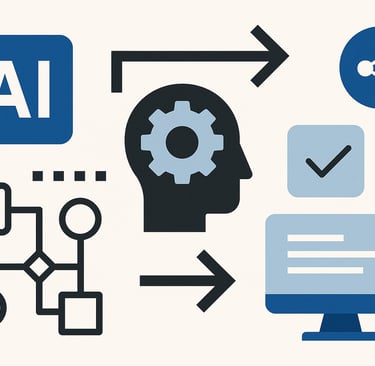
The race to build effective artificial-intelligence agents is entering a new phase, focusing on a set of complex challenges. While large language models (LLMs) have made significant strides, there's a growing emphasis on integrating these models with various tools necessary for efficient task execution. For instance, a sophisticated LLM might struggle with complex multiplication, yet an older, simpler model can perform well if given access to a calculator tool.
One of the major hurdles for AI agents is gaining permission to access applications, APIs, and websites. This need has become increasingly apparent as expectations grow for agents to perform tasks like booking flights or hailing rides. Unlike humans, who can easily authenticate themselves with passwords or biometric data, AI agents require new authorization methods to bridge the gap between human users and the services they wish to access, as highlighted by Alex Salazar, CEO of Arcade.dev (https://arcade.dev) .
A prime example of the potential capabilities of AI agents was shared during a presentation at Apple’s developer conference. A hypothetical scenario featured an advanced version of Siri, which could check flight details and calendar events to provide real-time updates for a user’s lunch plans. While this may sound like a futuristic dream, the AI ecosystem is actively working on the underlying frameworks that will make such complex interactions possible.
The introduction of the Model Context Protocol (MCP) by Anthropic (https://www.anthropic.com) has set the stage for more standardized connections between AI models and various data sources. Just as USB-C has simplified device connectivity, MCP aims to streamline how AI agents can interact with different tools and services.
Salazar notes that the evolution of tool-calling agents represents a new phase in AI agent development. His startup, Arcade.dev, is focused on creating solutions to help agents authenticate and interact with websites and APIs. Recently, they raised $12 million in seed funding to further this mission, with backing from notable investors like Laude Ventures and Flybridge Ventures.
Integrating AI agents with essential applications like email and calendar services is expected to be a significant challenge. Salazar believes that as agents expand their capabilities, those that work with companies offering public APIs will have a better chance of success. However, many platforms limit API access to avoid misuse, and older systems may not have the necessary APIs at all.
As AI agents become more sophisticated, they will take on increasingly complex tasks, such as drafting communications and planning itineraries, though human confirmation will still be needed initially. Salazar anticipates a shift towards fully autonomous agents performing low-risk tasks over the next couple of years. Once these engineering challenges are resolved, we may be on the brink of a technological transformation that could rival the impact of app stores introduced in 2008.
Cited: https://www.wsj.com/articles/ai-agents-face-one-last-big-obstacle-ef3ea7f5?st=CsXXy7
Your Data, Your Insights
Unlock the power of your data effortlessly. Update it continuously. Automatically.
Answers
Sign up NOW
info at aimaker.com
© 2024. All rights reserved. Terms and Conditions | Privacy Policy