
Preparing for the Future of Multiagent Systems
Companies are moving towards multiagent systems to enhance operations across various sectors. Accenture and others are leading the charge with innovative solutions. Preparing now can help businesses leverage these advancements effectively.
WORKAGENTSINVESTINGUSAGEFUTURETOOLS
The AI Maker
2/16/20262 min read

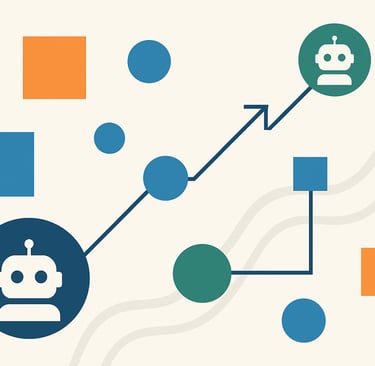
As artificial intelligence (AI) continues to evolve, businesses are on the brink of a major transformation: the orchestration of multiple AI agents. While many companies are still learning how to deploy a single AI-powered agent, developers are already creating protocols to enable teams of agents to work together. These multiagent systems promise to streamline operations across various domains, from customer service and marketing to finance and logistics.
According to Lan Guan, the Chief AI Officer at Accenture (https://www.accenture.com) , only 10% to 15% of her clients currently utilize multiagent systems. However, she anticipates that this number will rise to over 30% within the next 18 to 24 months. Accenture has already developed a 15-agent system for marketing, featuring three “super agents” coordinating 12 specialized agents to plan campaigns around topics like “2025 trends.”
Accenture's multiagent systems are not just theoretical; they are already being adopted by major clients, including BMW (https://www.bmw.com) , Unilever (https://www.unilever.com) , and ESPN (https://www.espn.com) . With more than 50 multiagent systems in operation across various industries, Accenture expects this figure to exceed 100 by the end of the year.
Moreover, interoperability between agents is becoming a reality. At the recent Google Next conference, Salesforce (https://www.salesforce.com) and Google (https://cloud.google.com) announced their collaboration on a protocol called A2A (Agent-to-Agent). This protocol allows agents within Salesforce’s ecosystem to communicate with each other and external agents, focusing on crucial areas like authentication and message passing.
A practical example of multiagent systems in action is Keyway (https://www.keyway.com) , a New York-based commercial real estate tech startup. They provide a platform that enables asset and property managers to use coordinated interactions between agents to answer complex questions, such as optimal rental pricing and targeted amenities.
To prepare for the integration of multiagent systems, companies should start by developing standard, stand-alone agents. This foundational step will allow organizations to orchestrate agents into more complex and collaborative systems once the necessary protocols are in place. For instance, Principal Financial Group (https://www.principal.com) has already embedded individual AI agents across various domains, such as software engineering and claims processing, and is building a technical framework to support agent-to-agent collaboration.
As the landscape of AI continues to shift, the potential applications for multiagent systems are vast. From optimizing retirement services to enhancing asset management through real-time collaboration, the future of work is increasingly intertwined with intelligent agents. The key takeaway? Start preparing now, as the future of multiagent systems is just around the corner.
Your Data, Your Insights
Unlock the power of your data effortlessly. Update it continuously. Automatically.
Answers
Sign up NOW
info at aimaker.com
© 2024. All rights reserved. Terms and Conditions | Privacy Policy