
Rethinking AI: The Limits of Current Models
Current AI models excel at simulating intelligence but may lack true reasoning capabilities. Research reveals that they operate more like complex systems of heuristics than human-like thinkers. Understanding these limitations can help refine future AI developments.
USAGEFUTURERESEARCHTOOLS
The AI Maker
12/29/20252 min read

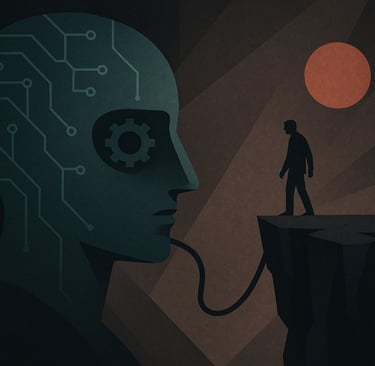
The landscape of artificial intelligence is buzzing with predictions from industry giants like OpenAI (https://www.openai.com) , Anthropic (https://www.anthropic.com) , and Google (https://www.google.com) . They suggest that achieving human-level intelligence is just around the corner. However, a growing chorus of skeptics argues that the current models simply don’t think like humans do.
Research indicates there are fundamental limitations in today’s AI architectures. Current AI models excel at simulating intelligence by learning numerous rules of thumb, which they apply selectively to the information they encounter. This is a stark contrast to how humans and animals build complex “world models” that encompass cause and effect.
Many AI engineers assert that their models possess these world models within their intricate webs of artificial neurons, as evidenced by their ability to generate fluent prose that appears to indicate reasoning. Yet, recent advancements in a field called “mechanistic interpretability” are shedding light on the inner workings of these models. This newfound visibility has led many to question the assumption that we are on the brink of achieving artificial general intelligence (AGI).
Melanie Mitchell, a professor at the Santa Fe Institute (https://www.santafe.edu) , highlights a growing controversy surrounding the language used to describe AI capabilities. She suggests that these models may instead be developing colossal “bags of heuristics” rather than efficient mental models. This theory resonates with AI researcher Keyon Vafa from Harvard University (https://www.harvard.edu) , who found that AI systems trained on navigation data produced results that were anything but intuitive.
In Vafa’s experiments, the AI generated a navigational model that included impossible routes, yet managed to provide accurate directions 99% of the time. This points to a complex way of problem-solving that is unique to AI, as opposed to human-like reasoning. Further studies reveal that these models often learn different rules for specific tasks, such as basic arithmetic, which can lead to inefficiencies and inaccuracies.
These findings suggest that current AI systems are overly complex and resemble patched-together Rube Goldberg machines, relying on ad-hoc solutions to respond to prompts. This complexity may explain why they struggle when faced with unfamiliar scenarios. While humans can adapt flexibly to new situations, AI models often falter when even minor changes occur.
Despite these limitations, AI is undeniably reshaping our lives, and its presence is here to stay. Developers are gradually discovering how to leverage these systems for improved productivity. Understanding the constraints of AI thinking could pave the way for enhancements in the future, leading to more accurate, trustworthy, and controllable models.
Cited: https://www.wsj.com/tech/ai/how-ai-thinks-356969f8?mod=Searchresults_pos1&page=1
Your Data, Your Insights
Unlock the power of your data effortlessly. Update it continuously. Automatically.
Answers
Sign up NOW
info at aimaker.com
© 2024. All rights reserved. Terms and Conditions | Privacy Policy