
The Balancing Act of AI and Human Employees
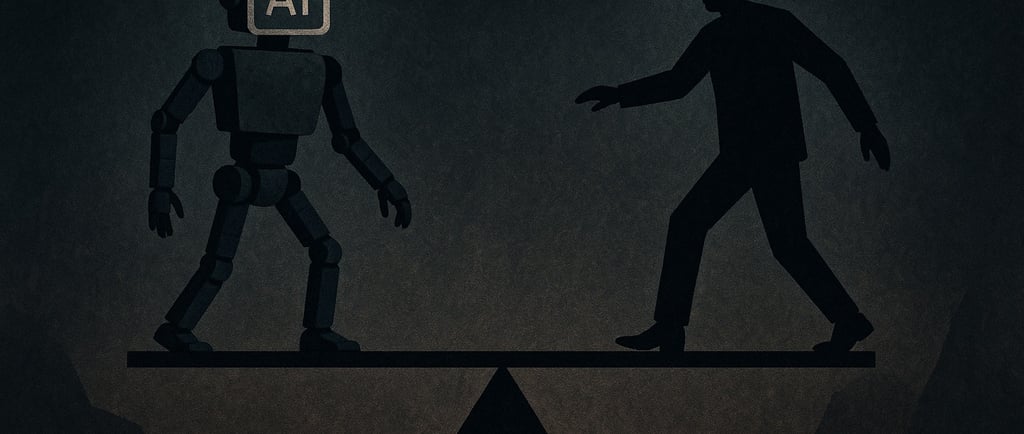
The integration of AI in the workplace presents both opportunities and challenges. While AI can enhance efficiency, it requires ongoing maintenance and governance similar to human employees. The best approach combines the strengths of both AI and human talent for optimal results.
WORKUSAGEFUTUREINVESTINGTOOLS
The AI Maker
11/3/20252 min read
When OpenAI made headlines with its ChatGPT launch in 2022, the conversation around AI in the workplace shifted dramatically. As technology evolves, many organizations are considering AI as an alternative to human employees. But is this a smart business move or just inviting chaos into the office?
AI workers come with their own set of challenges. While they don’t require salaries or sick leave, they do need regular maintenance and updates to function effectively. Think of system downtime as the AI equivalent of a holiday. Although AI can work around the clock, if it isn’t properly maintained, that 24/7 availability can quickly turn into a liability.
A recent report by Splunk highlighted that unplanned downtime costs the largest 2,000 companies a staggering $400 billion annually. This is a reminder that while AI can enhance efficiency, it can also lead to significant hidden costs if not properly managed. Ensuring that AI systems are up-to-date and performing at their best should be a top priority for any organization that integrates AI into its workforce.
Another aspect to consider is AI hallucinations. Unlike human employees who can call in sick, AI can generate incorrect or nonsensical outputs, which can be disruptive. For instance, Microsoft’s AI chatbot Tay had to be taken offline within a day of its launch due to inappropriate tweets. This highlights the importance of ongoing governance to manage and monitor AI performance, similar to how HR manages human talent.
Additionally, the misconception that AI is a one-time investment needs addressing. As AI continues to evolve, businesses may find themselves needing to invest in updates or entirely new systems to stay competitive. Just like providing pay raises for human employees, maintaining AI solutions requires ongoing financial commitment.
Training is another critical area where AI mirrors human employees. LLMs (Large Language Models) require extensive, high-quality data to improve their performance. Companies are now adopting techniques like Retrieval-Augmented Generation (RAG) to enhance the accuracy of AI models, which is akin to continuous training for human staff.
Ultimately, the question isn’t whether AI or human employees are better for business; rather, it’s about how to harness the strengths of both. While AI can automate certain tasks, the unique human capabilities of creativity, empathy, and strategic thinking remain irreplaceable. By combining the efficiency of AI with human ingenuity, businesses can achieve a more balanced and successful operation.
Cited: https://www.techradar.com/pro/the-hidden-complexities-of-ai-employees (https://www.techradar.com/pro/the-hidden-complexities-of-ai-employees)
Your Data, Your Insights
Unlock the power of your data effortlessly. Update it continuously. Automatically.
Answers
Sign up NOW
info at aimaker.com
© 2024. All rights reserved. Terms and Conditions | Privacy Policy