
The Evolving Role of Software Engineers in an AI-Driven World
The rise of AI tools is reshaping the role of software engineers, leading to decreased entry-level positions while increasing demand for experienced developers. While AI can automate certain coding tasks, it lacks the creativity and problem-solving skills that seasoned engineers possess. The future of software engineering may be bright for those who adapt and leverage AI as a collaborative tool.
WORKINVESTINGFUTUREUSAGETOOLS
The AI Maker
4/6/20262 min read
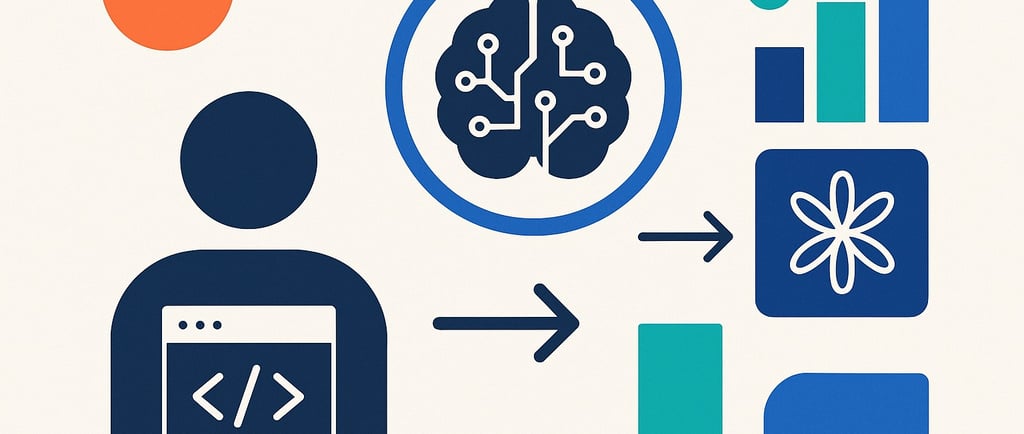
The landscape of software engineering is shifting, and AI is at the heart of this transformation. With generative AI tools like ChatGPT (https://openai.com/chatgpt) and Meta (https://www.meta.com) ’s AI engineer, the way we think about coding—and the roles of engineers—are being redefined.
In 2023, a poll conducted on the workplace forum Blind (https://www.teamblind.com) revealed that a significant number of young software engineers felt uncertain about their future, with 42% responding that they were "pretty much fucked." This sentiment reflects broader concerns about job security as AI begins to take over more coding tasks traditionally performed by entry-level engineers.
Despite these fears, the reality is more nuanced. AI might be automating some coding tasks, but it also increases the demand for skilled developers who can interpret and leverage AI-generated code effectively. As James Stanger (https://www.comptia.org) , chief technology evangelist at CompTIA (https://www.comptia.org) , points out, AI lacks the creative thinking necessary for problem-solving, which is where experienced engineers excel.
The Bureau of Labor Statistics projects that the software development field will grow by 17% from 2023 to 2033, outpacing the average for all jobs. However, there’s a noticeable trend: job postings for entry-level roles have decreased, while demand for experienced engineers has surged. This shift suggests that while junior roles are becoming less common, the need for seasoned professionals remains strong.
Experienced engineers like Jeremy Chua (https://georgianpartners.com) from Georgian find that AI tools augment their work rather than replace it. Chua notes that he can complete projects in a fraction of the time, viewing AI as a coding partner rather than a competitor. Similarly, Caleb Tonkinson (https://www.smarterdx.com) from SmarterDx emphasizes that AI allows him to deliver better results more quickly, enhancing rather than diminishing his role.
Yet, the concerns of younger engineers are valid. With AI tools like Cognition AI (https://www.cognition.ai) ’s Devin stepping in to handle smaller tasks, the traditional learning curve for junior developers could be disrupted. Alexander Petros (https://www.openai.com) , a freelance engineer, highlights the risk that reliance on AI could hinder the essential learning experiences that come from trial and error.
In conclusion, while AI is undoubtedly changing the landscape of software engineering, it isn’t heralding the end of the profession. Instead, it presents an opportunity for engineers—especially those with creativity and experience—to leverage these technologies to tackle deeper problems. The future of software engineering may not be as bleak as some fear; it could simply be evolving into something more complex and rewarding.
Your Data, Your Insights
Unlock the power of your data effortlessly. Update it continuously. Automatically.
Answers
Sign up NOW
info at aimaker.com
© 2024. All rights reserved. Terms and Conditions | Privacy Policy