
The Future of Work: AI's Impact on Healthcare and Jobs
Geoffrey Hinton, known as the Godfather of AI, predicts that healthcare jobs will be safe from automation, unlike many other sectors. While AI enhances efficiency, roles involving mundane tasks are more vulnerable. The human touch in healthcare remains irreplaceable, emphasizing the importance of empathy in medical care.
WORKFUTUREUSAGETOOLS
The AI Maker
7/13/20262 min read
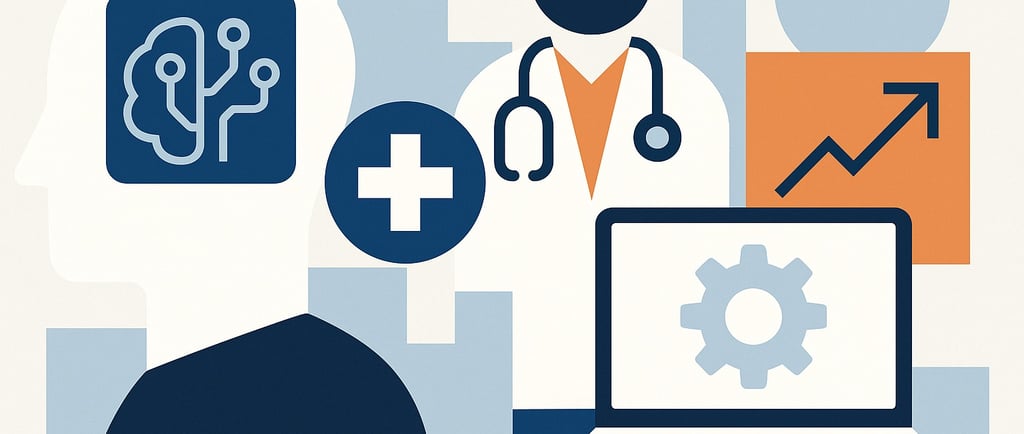
As we step into a world increasingly influenced by artificial intelligence (AI), opinions remain divided among CEOs and experts regarding the future of work. One prominent voice in this discussion is Geoffrey Hinton, often referred to as the Godfather of AI. Hinton recently shared insights on The Diary of a CEO (https://www.youtube.com/watch?v=XYZ) YouTube series, asserting that while many jobs may face automation, healthcare will likely remain a safe haven.
Hinton explains that AI can significantly enhance efficiency in healthcare. He notes, "If you could make doctors five times as efficient, we could all have five times as much healthcare for the same price." This perspective is buoyed by the observation that patients always seek more healthcare when it’s accessible. Interestingly, this sentiment stands in stark contrast to other sectors, where mundane tasks are increasingly vulnerable to AI takeover.
According to Hinton, roles that involve repetitive and mundane tasks, such as receptionists and customer service representatives, are at high risk. He warns that, “You’d have to be very skilled to have a job that it couldn’t just do.” This stark reality paints a picture of a future where many jobs may be eliminated, leaving only those requiring specialized skills.
Tech leaders like Jensen Huang offer a more optimistic view, suggesting that AI will augment human roles rather than replace them. However, Hinton’s outlook is more cautious, emphasizing that most jobs won’t benefit from AI in the same way. He points out that while some roles may become more efficient with AI assistance, many jobs will simply vanish.
This perspective is echoed by major consulting firms and banks. For instance, McKinsey (https://www.mckinsey.com) predicts that by 2030, 30% of current U.S. jobs could be automated, while Goldman Sachs (https://www.goldmansachs.com) foresees up to 50% of jobs potentially being fully automated by 2045.
Despite the looming threat to many sectors, healthcare appears to be a stronghold for job security. Leaders in the industry, like the CEO of Anthropic (https://www.anthropic.com) , acknowledge that many entry-level white-collar jobs are at risk due to AI. However, healthcare roles are expected to thrive. A 2024 report from McKinsey highlights that AI still cannot perform essential tasks that healthcare workers manage daily.
Moreover, the human touch in healthcare remains irreplaceable. As Demis Hassabis (https://deepmind.com) , CEO of Google’s AI research lab DeepMind, points out, while AI can enhance productivity, the empathy and human connection in medical care cannot be replicated by machines. “You wouldn’t want a robot nurse—there’s something about the human empathy aspect of that care that’s particularly humanistic,” he remarked.
In summary, while AI is reshaping the labor market, healthcare stands out as a sector poised for growth. The integration of AI may enhance efficiency, but the core of healthcare will likely remain centered on human interaction and care.
Your Data, Your Insights
Unlock the power of your data effortlessly. Update it continuously. Automatically.
Answers
Sign up NOW
info at aimaker.com
© 2024. All rights reserved. Terms and Conditions | Privacy Policy