
Understanding AI's Advantages Over Humans
AI has notable advantages over humans in speed, scale, scope, and sophistication. Understanding these dimensions can help navigate the evolving workforce landscape. By recognizing where AI excels, we can better appreciate its role alongside human talents.
USAGEFUTUREWORKINVESTINGTOOLS
The AI Maker
7/6/20262 min read
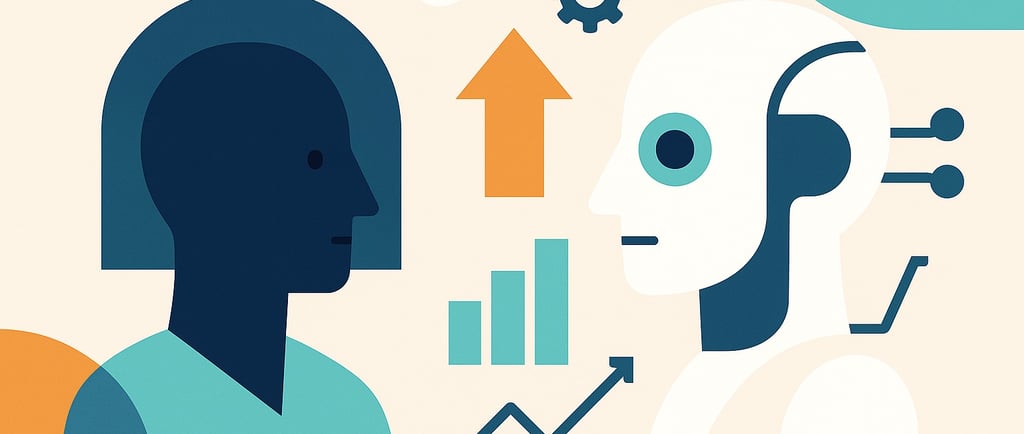
If you’ve ever worried that AI might take your job, you’re not alone. While recent AI mishaps—like recommending glue as a pizza topping—might offer some comfort, it’s important to understand where AI truly excels and where it doesn't. Knowing these strengths can help you adapt to an AI-infused workforce.
AI's advantages can be categorized into four dimensions: speed, scale, scope, and sophistication. Let’s dive into each one.
Speed : AI can perform certain tasks much faster than humans. For example, when it comes to restoring or upscaling images, AI can process large amounts of data in a flash. This capability is crucial for applications in industries such as satellite imaging and video game development, where real-time performance is essential.
Scale : While humans can target ads effectively, AI can do so across millions of users simultaneously. The modern ad-tech industry thrives on this capability, enabling real-time bidding for advertisements. This scalability is a game changer in the trillion-dollar advertising market.
Scope : AI can handle a variety of tasks that would be challenging for a single human. Generative AI models like ChatGPT can engage in conversations, write essays, and even code—often outperforming humans when considering the breadth of capabilities. While a specialist may excel in a specific area, AI's versatility can provide valuable support in various tasks.
Sophistication : AI systems can analyze a multitude of factors simultaneously, offering a level of performance that can surpass human capabilities in specialized tasks. For instance, the groundbreaking work of AlphaFold2, which won a Nobel Prize in Chemistry in 2024, illustrates how AI can revolutionize complex fields like structural biology by predicting how proteins fold based on intricate interactions.
While these dimensions highlight where AI can excel, context is crucial. Accuracy remains important; a glitchy AI graphic or a poorly targeted ad won't cut it. However, AI doesn’t need to be superhuman—being merely good and fast can often suffice. It’s also worth noting that as AI takes over certain tasks, the nature of those tasks may change entirely, leading to new strategies and risks.
In conclusion, when evaluating new AI applications or considering them as replacements for human roles, remember to assess the bottlenecks in speed, scale, scope, and sophistication. This framework can help you identify where AI adds value and where human capabilities still shine.
Your Data, Your Insights
Unlock the power of your data effortlessly. Update it continuously. Automatically.
Answers
Sign up NOW
info at aimaker.com
© 2024. All rights reserved. Terms and Conditions | Privacy Policy